
Agent Engine
You want AI agents running your revenue motions. You also need to know exactly what they're doing and why. Every revenue leader sees the potential. An agent that runs ABM campaigns against your top 200 accounts — monitoring signals, building personalized creative for every persona in the buying committee, and activating across channels the moment intent spikes. Or one that adapts nurture sequences for thousands of mid-funnel leads based on real-time behavior, escalating the right ones to sales with full context. The math is obvious. The holdback is trust. When an agent launches a personalized campaign against your largest strategic account, who approved the messaging? When it escalates a lead to your top AE based on a score nobody can explain, what happens in the pipeline review? When it adapts a nurture sequence and conversion drops, can anyone trace which decision changed and why — or is the answer "the AI decided"? Most AI agent platforms are closed systems. The model that scores your accounts is proprietary. The logic that decides which creative runs against which persona is a black box. The workflow that manages your highest-value campaigns runs in someone else's cloud with no audit trail your team can read. You're asked to trust AI with the accounts your business depends on while having less visibility into the decision-making than you had when a human ran the plays manually. The Agent Engine is open-source. Every decision has an execution trace. Every workflow is inspectable code, not a proprietary black box. Every output goes through an approval gate before it touches a prospect or a CRM record. Brief it like you'd brief your best operator — the objective, the constraints, the standards — and get outcomes with full accountability.
You want AI agents running your revenue motions. You also need to know exactly what they're doing and why. Every revenue leader sees the potential. An agent that runs ABM campaigns against your top 200 accounts — monitoring signals, building personalized creative for every persona in the buying committee, and activating across channels the moment intent spikes. Or one that adapts nurture sequences for thousands of mid-funnel leads based on real-time behavior, escalating the right ones to sales with full context. The math is obvious. The holdback is trust. When an agent launches a personalized campaign against your largest strategic account, who approved the messaging? When it escalates a lead to your top AE based on a score nobody can explain, what happens in the pipeline review? When it adapts a nurture sequence and conversion drops, can anyone trace which decision changed and why — or is the answer "the AI decided"? Most AI agent platforms are closed systems. The model that scores your accounts is proprietary. The logic that decides which creative runs against which persona is a black box. The workflow that manages your highest-value campaigns runs in someone else's cloud with no audit trail your team can read. You're asked to trust AI with the accounts your business depends on while having less visibility into the decision-making than you had when a human ran the plays manually. The Agent Engine is open-source. Every decision has an execution trace. Every workflow is inspectable code, not a proprietary black box. Every output goes through an approval gate before it touches a prospect or a CRM record. Brief it like you'd brief your best operator — the objective, the constraints, the standards — and get outcomes with full accountability.
The runtime that turns briefs into outcomes. Open-source. Auditable. Yours.
The runtime that turns briefs into outcomes. Open-source. Auditable. Yours.
Twelve systems, one truth
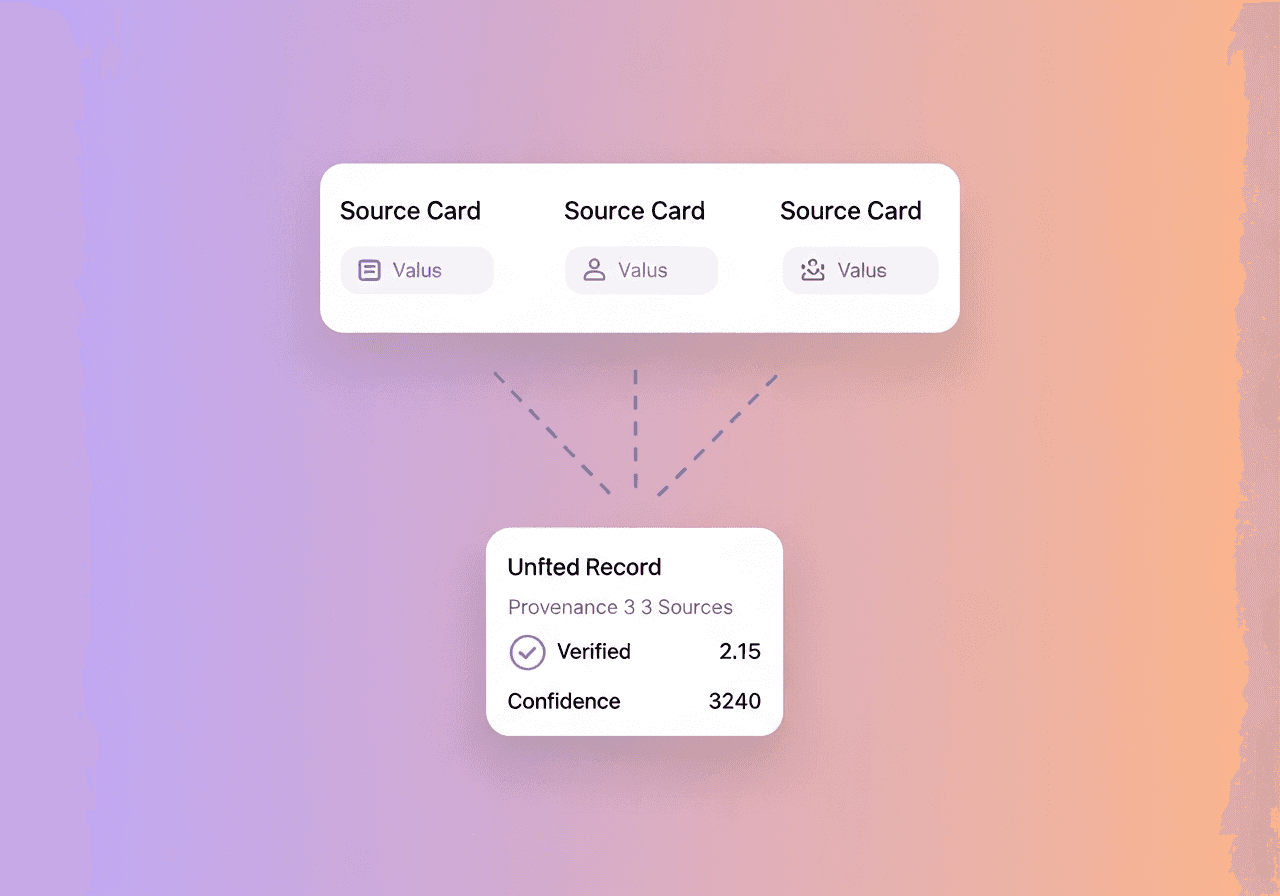
Your CRM says Acme Corp has 1,200 employees. Your enrichment provider says 1,450. Your intent vendor has them under a subsidiary name your CRM doesn't recognize. The Ontology resolves these — matching entities across name, domain, phone, title, company, and behavior, then merging them into one record with provenance on every field. Clear matches merge automatically. Ambiguous cases surface for review. Every merge is reversible. The result isn't a "master record" that overwrites everything — it's a graph where every value has a source, a timestamp, and a confidence score, and the best answer wins.
Twelve systems, one truth
Your CRM says Acme Corp has 1,200 employees. Your enrichment provider says 1,450. Your intent vendor has them under a subsidiary name your CRM doesn't recognize. The Ontology resolves these — matching entities across name, domain, phone, title, company, and behavior, then merging them into one record with provenance on every field. Clear matches merge automatically. Ambiguous cases surface for review. Every merge is reversible. The result isn't a "master record" that overwrites everything — it's a graph where every value has a source, a timestamp, and a confidence score, and the best answer wins.
Every question is one query, not three exports
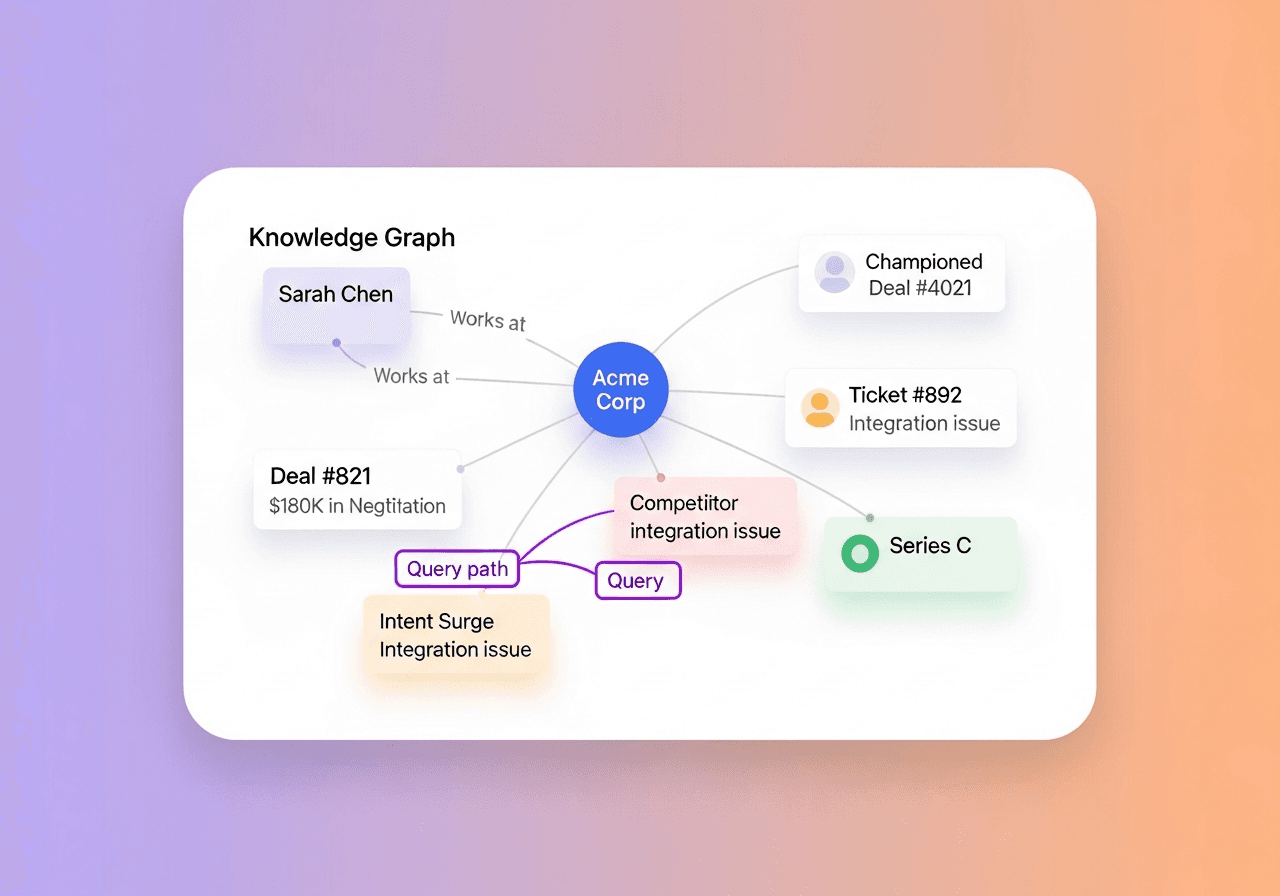
An AE wants to know: which accounts have a champion who opened a support ticket about a competitor in the last 90 days, are in an active deal above $100K, and showed an intent surge this quarter? Today that's three system exports, a VLOOKUP, and an hour. The Ontology stores relationships natively — person-to-company, person-to-deal, deal-to-signal, signal-to-account — so that query runs in seconds against the graph. Agents don't reconstruct context by joining CSVs. They read it directly.
Every question is one query, not three exports
An AE wants to know: which accounts have a champion who opened a support ticket about a competitor in the last 90 days, are in an active deal above $100K, and showed an intent surge this quarter? Today that's three system exports, a VLOOKUP, and an hour. The Ontology stores relationships natively — person-to-company, person-to-deal, deal-to-signal, signal-to-account — so that query runs in seconds against the graph. Agents don't reconstruct context by joining CSVs. They read it directly.
The model bends to your business, not the other way around
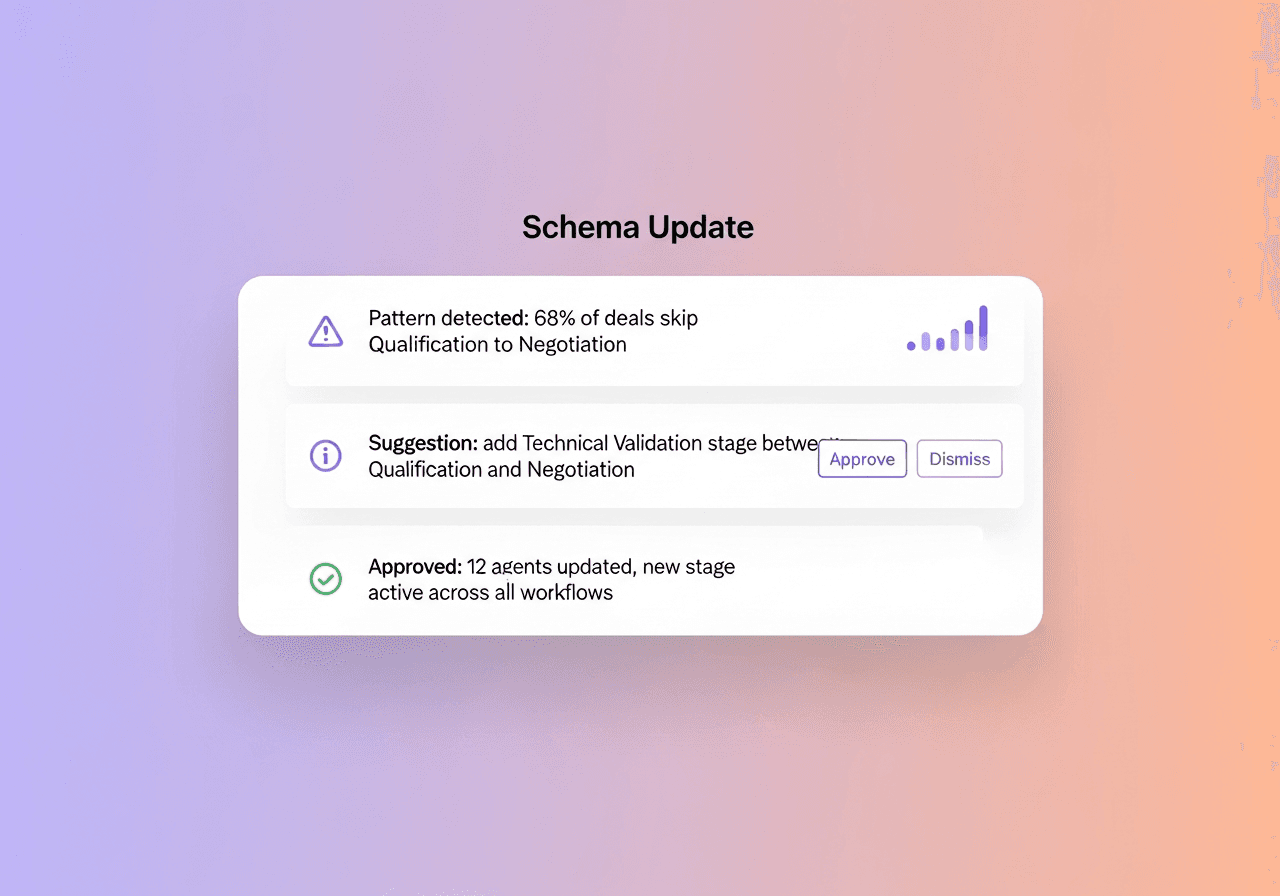
Out-of-the-box data models force your business into someone else's schema. Your CRM says deals go Qualification → Negotiation, but your reps run a Technical Validation step in between that doesn't exist in the system. Your team calls a certain type of intent signal a "budget unlock" — no vendor's taxonomy includes that. The Ontology detects these gaps from usage patterns and proposes schema updates. When your team overrides a signal classification or skips a deal stage, the system learns what those patterns mean for your business specifically and suggests structural changes. Approve them and every agent immediately operates on the updated model.
The model bends to your business, not the other way around
Out-of-the-box data models force your business into someone else's schema. Your CRM says deals go Qualification → Negotiation, but your reps run a Technical Validation step in between that doesn't exist in the system. Your team calls a certain type of intent signal a "budget unlock" — no vendor's taxonomy includes that. The Ontology detects these gaps from usage patterns and proposes schema updates. When your team overrides a signal classification or skips a deal stage, the system learns what those patterns mean for your business specifically and suggests structural changes. Approve them and every agent immediately operates on the updated model.
Signals mean what they mean for your business
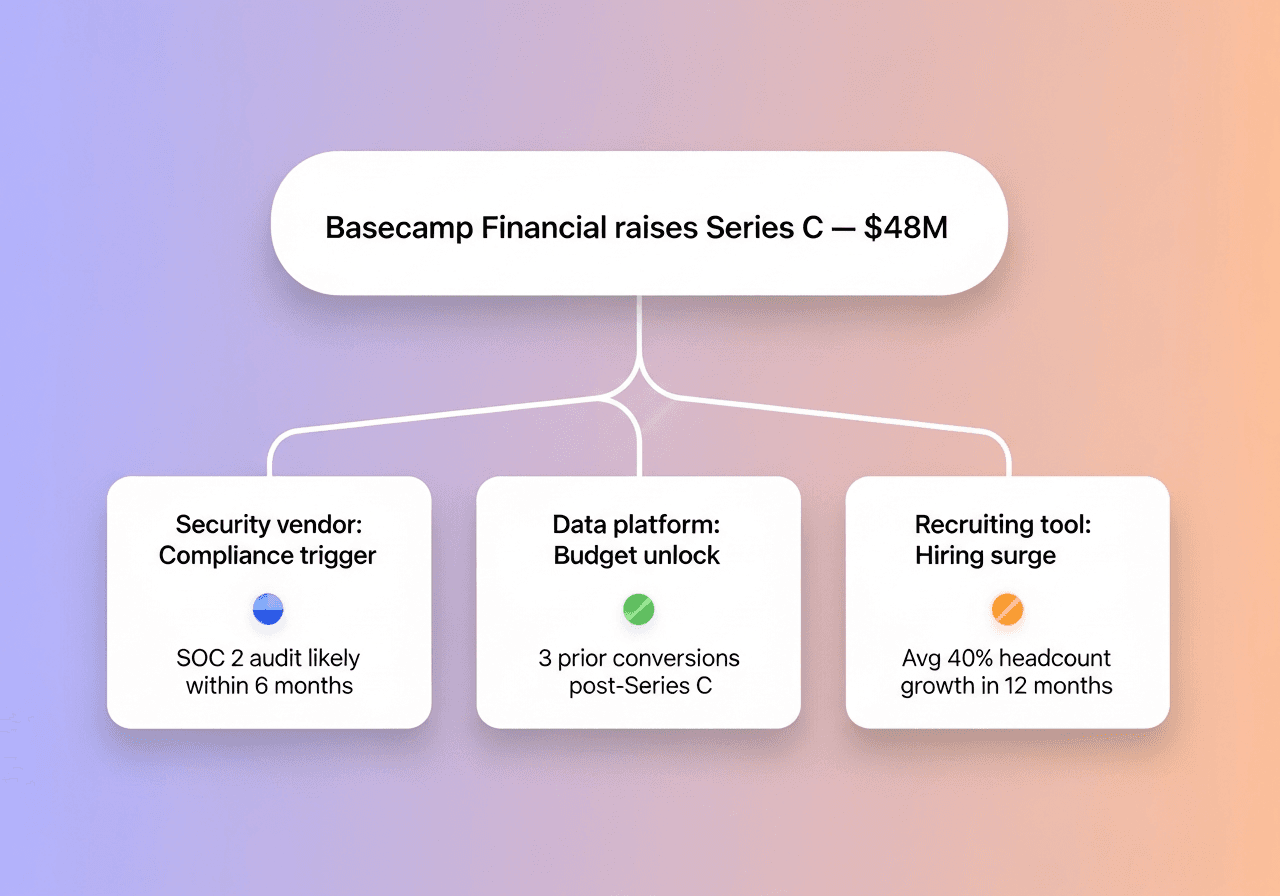
A Series C means different things to different companies selling different products. For a security vendor, it's a compliance trigger — the company just hit the size where SOC 2 becomes mandatory. For a data platform, it's a budget unlock — new money, new infrastructure spend. For a recruiting tool, it's a hiring surge. Generic intent platforms assign one score to one event. The Ontology classifies signals based on your industry, your ICP, your competitive landscape, and your historical conversion patterns. The same event gets a different weight, a different classification, and a different downstream action depending on whose Ontology it's in.
Signals mean what they mean for your business
A Series C means different things to different companies selling different products. For a security vendor, it's a compliance trigger — the company just hit the size where SOC 2 becomes mandatory. For a data platform, it's a budget unlock — new money, new infrastructure spend. For a recruiting tool, it's a hiring surge. Generic intent platforms assign one score to one event. The Ontology classifies signals based on your industry, your ICP, your competitive landscape, and your historical conversion patterns. The same event gets a different weight, a different classification, and a different downstream action depending on whose Ontology it's in.
Works with
Works with
Track Champions
Maintains a persistent watchlist of every closed-won champion. Reads from the Ontology for relationship history, calls the Waterfall to verify job changes across multiple providers, and drafts warm outbound with full approval gates.
Meeting Brief
Executes a timed research workflow 30 minutes before every external meeting. Pulls from the Ontology, enriches gaps through the Waterfall, and delivers the brief on the Engine's scheduler.
CRM Hygiene Expert
Runs scheduled maintenance workflows — deduplication, field completion, stale record refresh — with full audit trails showing every change, its source, and the reasoning behind it.
Data Waterfall
The enrichment service the Engine calls inline. When an agent needs data mid-workflow — a phone number, a tech stack, a buying committee — the Engine triggers the Waterfall and injects the result without interrupting the workflow.
ABM Strategist
Orchestrates a multi-phase workflow — account scoring, committee mapping, signal monitoring, campaign generation — with the Engine managing state across phases and approval gates between each one.
Signal-Based Outbound
Monitors signal streams continuously through the Engine's persistent execution model. Trigger weights adjust based on conversion data fed back through the learning loop.
Revenue Ontology
The shared data model every agent reads from and writes to. The Engine calls the Ontology on every read and every write — no caching layer, no stale copies. What one agent learns, every agent knows.
Track Champions
Maintains a persistent watchlist of every closed-won champion. Reads from the Ontology for relationship history, calls the Waterfall to verify job changes across multiple providers, and drafts warm outbound with full approval gates.
ABM Strategist
Orchestrates a multi-phase workflow — account scoring, committee mapping, signal monitoring, campaign generation — with the Engine managing state across phases and approval gates between each one.
Meeting Brief
Executes a timed research workflow 30 minutes before every external meeting. Pulls from the Ontology, enriches gaps through the Waterfall, and delivers the brief on the Engine's scheduler.
Signal-Based Outbound
Monitors signal streams continuously through the Engine's persistent execution model. Trigger weights adjust based on conversion data fed back through the learning loop.
CRM Hygiene Expert
Runs scheduled maintenance workflows — deduplication, field completion, stale record refresh — with full audit trails showing every change, its source, and the reasoning behind it.
Revenue Ontology
The shared data model every agent reads from and writes to. The Engine calls the Ontology on every read and every write — no caching layer, no stale copies. What one agent learns, every agent knows.
Data Waterfall
The enrichment service the Engine calls inline. When an agent needs data mid-workflow — a phone number, a tech stack, a buying committee — the Engine triggers the Waterfall and injects the result without interrupting the workflow.
Three layers, one platform by Lantern
Three layers, one platform by Lantern
Every agent runs on three layers: a unified data model, 150+ enrichment providers, and an open-source engine where every decision is auditable.
Every agent runs on three layers: a unified data model, 150+ enrichment providers, and an open-source engine where every decision is auditable.
Data Waterfall
150+ enrichment providers. Sequential routing optimized per segment. The best answer wins. No vendor lock-in.

Agent Engine
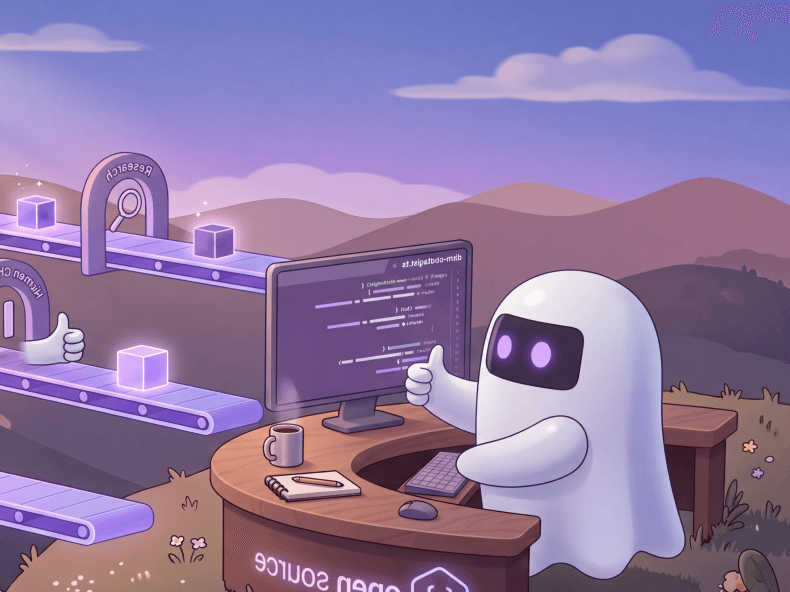
Open-source execution engine. Workflows defined in code. Human-in-the-loop checkpoints. Full audit trail on every action.
Revenue Ontology
Every data source normalized into one model. Entity resolution across systems. Relationships stored, not inferred. Schema that evolves with your business.
FAQ
FAQ
What is the Agent Engine, exactly?
Why open-source?
How long does it take to deploy an agent?
What happens when an agent makes a mistake?
Can our engineering team build custom agents?

Brief it like you'd brief your best operator. Then let it run.
Brief it like you'd brief your best operator. Then let it run.
USE CASES
Revenue Team
Marketing Team
Customer Success
PRICING
Pricing
RESOURCES
Blog
About Lantern
Status
Support
© LANTERN 2025
Terms
Privacy

USE CASES
Revenue Team
Marketing Team
Customer Success
PRICING
Pricing
RESOURCES
Blog
About Lantern
Status
Support
© LANTERN 2025
Terms
Privacy
USE CASES
Revenue Team
Marketing Team
Customer Success
PRICING
Pricing
RESOURCES
Blog
About Lantern
Status
Support
© LANTERN 2025
Terms
Privacy