
Data Waterfall
You're paying for three enrichment vendors and still can't get a clean phone number for half your accounts. ZoomInfo covers enterprise but misses mid-market. Apollo has strong email coverage but the phone numbers bounce. Clearbit used to be reliable on technographics until their coverage quietly dropped last quarter. Your team knows this — they've built the spreadsheet that cross-references all three, manually picks the best value per field, and prays the data isn't six months stale by the time the outbound sequence fires. The problem isn't that any one provider is bad. It's that you're running a manual vendor arbitrage operation on top of your actual job. Every new provider means a new contract, a new API integration, a new column in the reconciliation spreadsheet, and a new invoice to justify at renewal. When coverage degrades on one of them — and it always does — nobody notices until the bounce rate spikes and the pipeline review turns into a data quality autopsy. The Data Waterfall queries 150+ providers in a single call. Each field gets the best available answer. Coverage: 95%. Vendor management: zero. The spreadsheet is gone.
You're paying for three enrichment vendors and still can't get a clean phone number for half your accounts. ZoomInfo covers enterprise but misses mid-market. Apollo has strong email coverage but the phone numbers bounce. Clearbit used to be reliable on technographics until their coverage quietly dropped last quarter. Your team knows this — they've built the spreadsheet that cross-references all three, manually picks the best value per field, and prays the data isn't six months stale by the time the outbound sequence fires. The problem isn't that any one provider is bad. It's that you're running a manual vendor arbitrage operation on top of your actual job. Every new provider means a new contract, a new API integration, a new column in the reconciliation spreadsheet, and a new invoice to justify at renewal. When coverage degrades on one of them — and it always does — nobody notices until the bounce rate spikes and the pipeline review turns into a data quality autopsy. The Data Waterfall queries 150+ providers in a single call. Each field gets the best available answer. Coverage: 95%. Vendor management: zero. The spreadsheet is gone.
150+ data providers. One enrichment call. The best answer wins.
150+ data providers. One enrichment call. The best answer wins.
Twelve systems, one truth
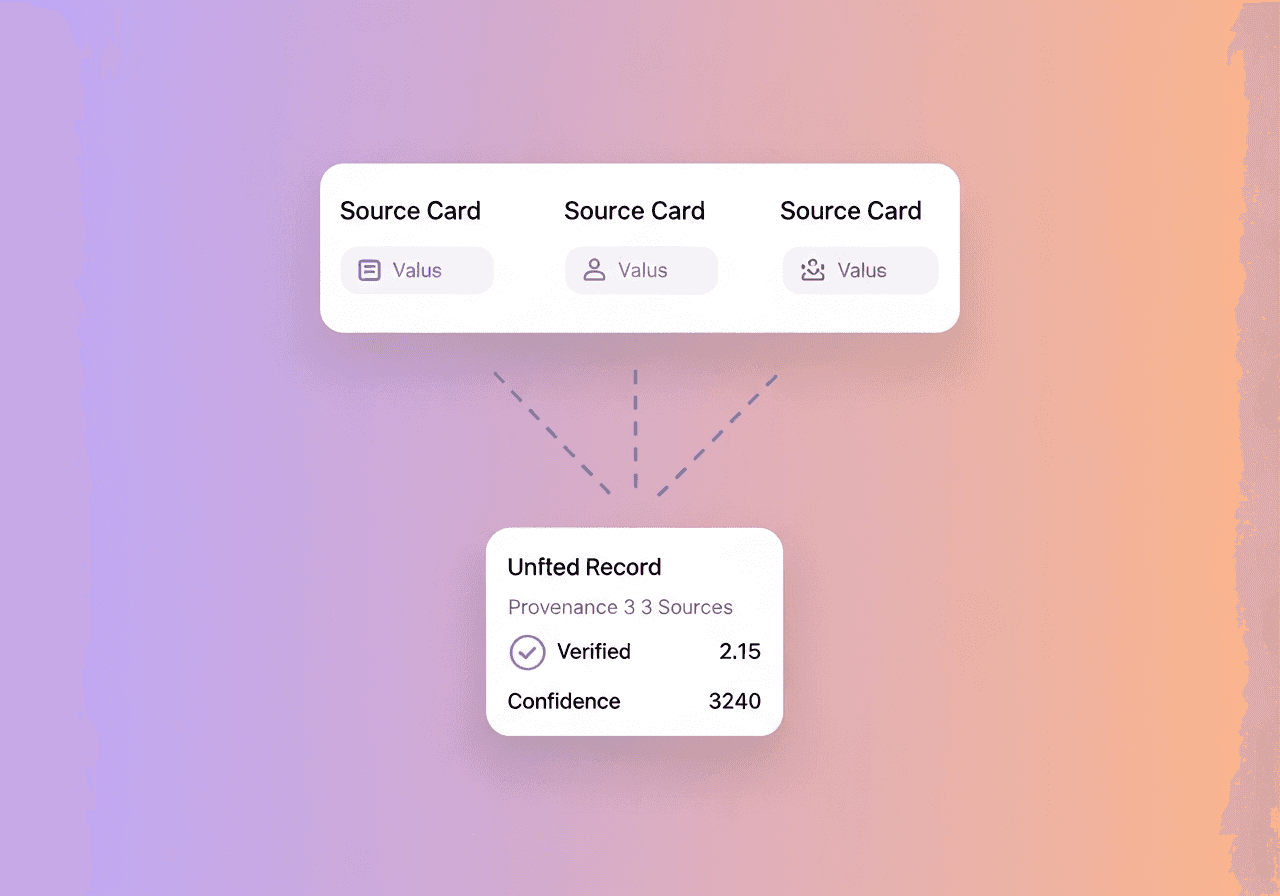
Your CRM says Acme Corp has 1,200 employees. Your enrichment provider says 1,450. Your intent vendor has them under a subsidiary name your CRM doesn't recognize. The Ontology resolves these — matching entities across name, domain, phone, title, company, and behavior, then merging them into one record with provenance on every field. Clear matches merge automatically. Ambiguous cases surface for review. Every merge is reversible. The result isn't a "master record" that overwrites everything — it's a graph where every value has a source, a timestamp, and a confidence score, and the best answer wins.
Twelve systems, one truth
Your CRM says Acme Corp has 1,200 employees. Your enrichment provider says 1,450. Your intent vendor has them under a subsidiary name your CRM doesn't recognize. The Ontology resolves these — matching entities across name, domain, phone, title, company, and behavior, then merging them into one record with provenance on every field. Clear matches merge automatically. Ambiguous cases surface for review. Every merge is reversible. The result isn't a "master record" that overwrites everything — it's a graph where every value has a source, a timestamp, and a confidence score, and the best answer wins.
Every question is one query, not three exports
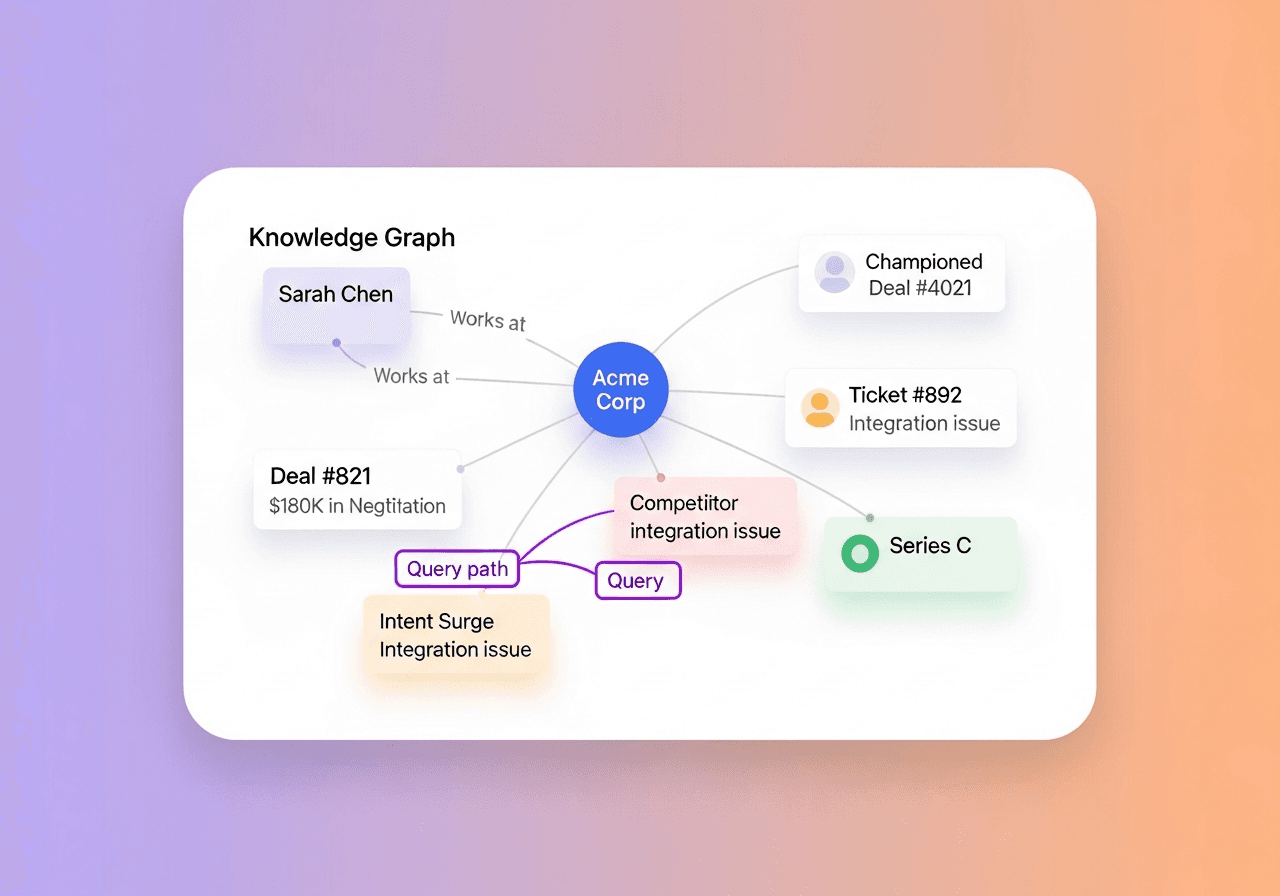
An AE wants to know: which accounts have a champion who opened a support ticket about a competitor in the last 90 days, are in an active deal above $100K, and showed an intent surge this quarter? Today that's three system exports, a VLOOKUP, and an hour. The Ontology stores relationships natively — person-to-company, person-to-deal, deal-to-signal, signal-to-account — so that query runs in seconds against the graph. Agents don't reconstruct context by joining CSVs. They read it directly.
Every question is one query, not three exports
An AE wants to know: which accounts have a champion who opened a support ticket about a competitor in the last 90 days, are in an active deal above $100K, and showed an intent surge this quarter? Today that's three system exports, a VLOOKUP, and an hour. The Ontology stores relationships natively — person-to-company, person-to-deal, deal-to-signal, signal-to-account — so that query runs in seconds against the graph. Agents don't reconstruct context by joining CSVs. They read it directly.
The model bends to your business, not the other way around
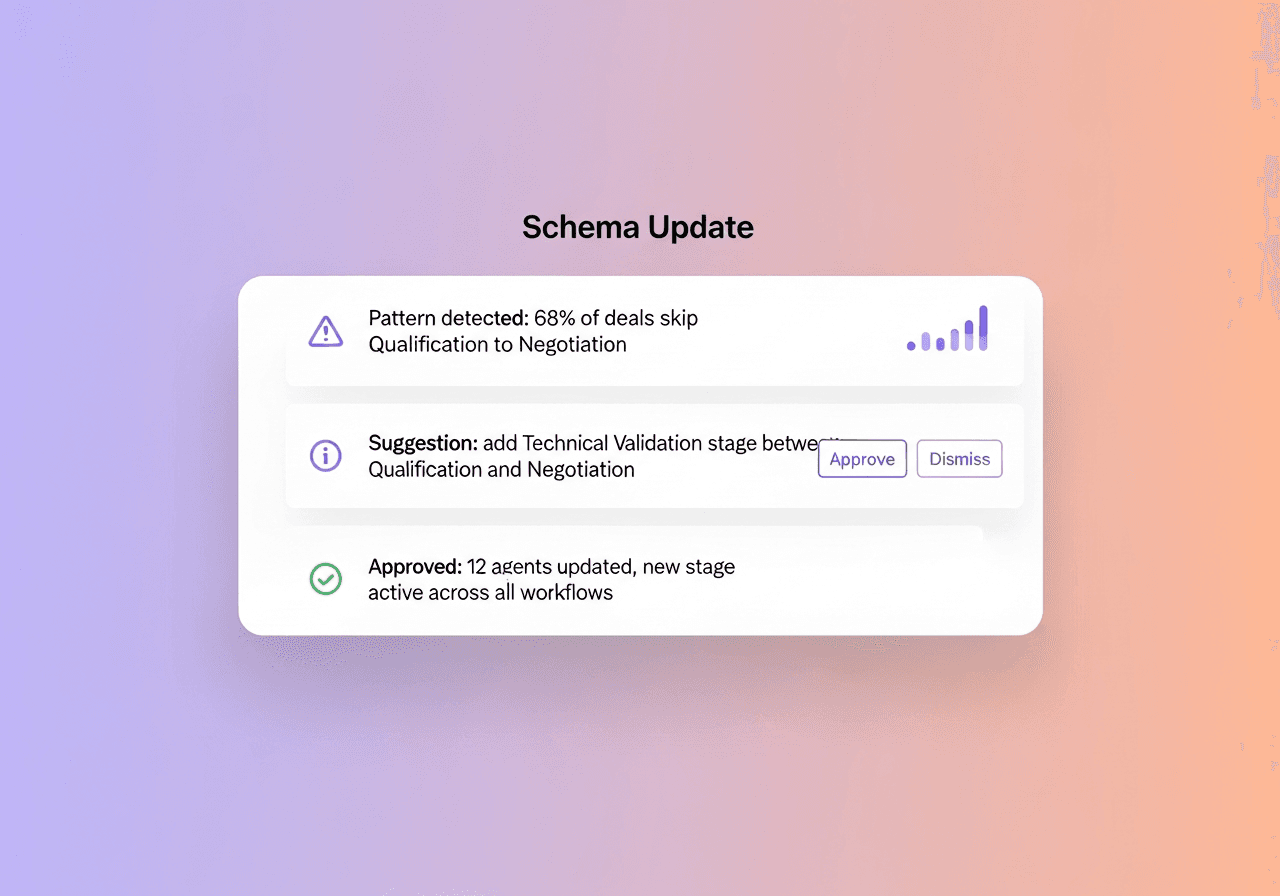
Out-of-the-box data models force your business into someone else's schema. Your CRM says deals go Qualification → Negotiation, but your reps run a Technical Validation step in between that doesn't exist in the system. Your team calls a certain type of intent signal a "budget unlock" — no vendor's taxonomy includes that. The Ontology detects these gaps from usage patterns and proposes schema updates. When your team overrides a signal classification or skips a deal stage, the system learns what those patterns mean for your business specifically and suggests structural changes. Approve them and every agent immediately operates on the updated model.
The model bends to your business, not the other way around
Out-of-the-box data models force your business into someone else's schema. Your CRM says deals go Qualification → Negotiation, but your reps run a Technical Validation step in between that doesn't exist in the system. Your team calls a certain type of intent signal a "budget unlock" — no vendor's taxonomy includes that. The Ontology detects these gaps from usage patterns and proposes schema updates. When your team overrides a signal classification or skips a deal stage, the system learns what those patterns mean for your business specifically and suggests structural changes. Approve them and every agent immediately operates on the updated model.
Signals mean what they mean for your business
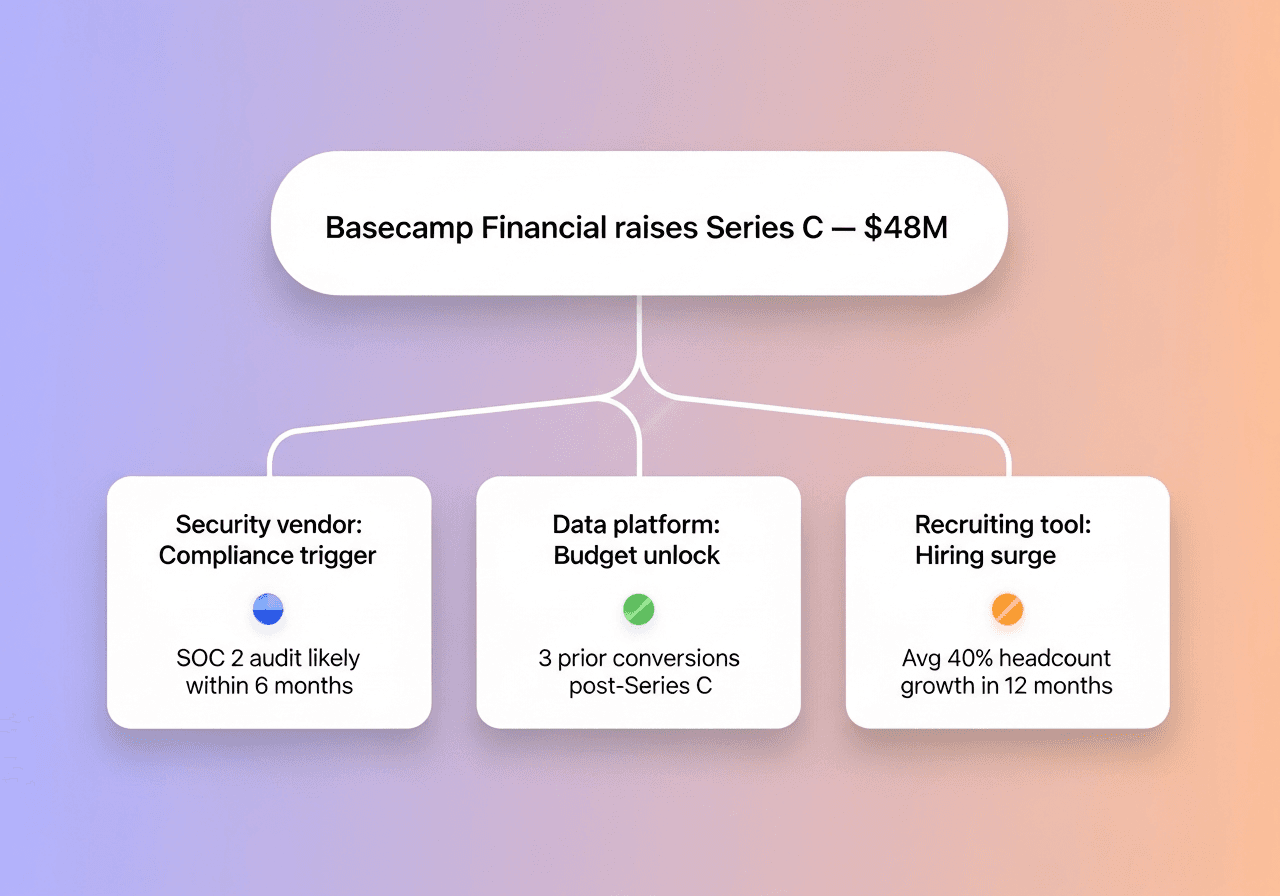
A Series C means different things to different companies selling different products. For a security vendor, it's a compliance trigger — the company just hit the size where SOC 2 becomes mandatory. For a data platform, it's a budget unlock — new money, new infrastructure spend. For a recruiting tool, it's a hiring surge. Generic intent platforms assign one score to one event. The Ontology classifies signals based on your industry, your ICP, your competitive landscape, and your historical conversion patterns. The same event gets a different weight, a different classification, and a different downstream action depending on whose Ontology it's in.
Signals mean what they mean for your business
A Series C means different things to different companies selling different products. For a security vendor, it's a compliance trigger — the company just hit the size where SOC 2 becomes mandatory. For a data platform, it's a budget unlock — new money, new infrastructure spend. For a recruiting tool, it's a hiring surge. Generic intent platforms assign one score to one event. The Ontology classifies signals based on your industry, your ICP, your competitive landscape, and your historical conversion patterns. The same event gets a different weight, a different classification, and a different downstream action depending on whose Ontology it's in.
Works with
Works with
ABM Strategist
Calls the Waterfall inline to enrich target accounts and verify buying committee contacts before building campaigns. No separate enrichment step.
Track Champions
Verifies champion job changes across multiple providers through the Waterfall. Single-source detection misses get caught by the cascade.
Personalized Outbound
Verifies every contact's email and phone through the Waterfall before sends. Bounced emails and wrong numbers caught before they damage sender reputation.
Agent Engine
The Waterfall is a skill the Engine calls. When an agent needs enrichment mid-workflow — buying committee contacts, a phone number for outbound, a tech stack check before a meeting brief — the Engine triggers the Waterfall inline. Enrichment is part of the workflow, not a separate process.
Inbound SDR
Triggers enrichment the instant a form is submitted. Name and email become a full firmographic, technographic, and contact profile before the routing logic fires.
CRM Hygiene Expert
Refreshes stale records on schedule through the Waterfall. Flags where enrichment data conflicts with existing CRM data and surfaces the provenance for review.
Revenue Ontology
Where enrichment results land. Every field merges into the knowledge graph with full provenance — source, confidence, timestamp. The Ontology's entity resolution deduplicates and unifies what the Waterfall enriches.
ABM Strategist
Calls the Waterfall inline to enrich target accounts and verify buying committee contacts before building campaigns. No separate enrichment step.
Inbound SDR
Triggers enrichment the instant a form is submitted. Name and email become a full firmographic, technographic, and contact profile before the routing logic fires.
Track Champions
Verifies champion job changes across multiple providers through the Waterfall. Single-source detection misses get caught by the cascade.
CRM Hygiene Expert
Refreshes stale records on schedule through the Waterfall. Flags where enrichment data conflicts with existing CRM data and surfaces the provenance for review.
Personalized Outbound
Verifies every contact's email and phone through the Waterfall before sends. Bounced emails and wrong numbers caught before they damage sender reputation.
Revenue Ontology
Where enrichment results land. Every field merges into the knowledge graph with full provenance — source, confidence, timestamp. The Ontology's entity resolution deduplicates and unifies what the Waterfall enriches.
Agent Engine
The Waterfall is a skill the Engine calls. When an agent needs enrichment mid-workflow — buying committee contacts, a phone number for outbound, a tech stack check before a meeting brief — the Engine triggers the Waterfall inline. Enrichment is part of the workflow, not a separate process.
Three layers, one platform by Lantern
Three layers, one platform by Lantern
Every agent runs on three layers: a unified data model, 150+ enrichment providers, and an open-source engine where every decision is auditable.
Every agent runs on three layers: a unified data model, 150+ enrichment providers, and an open-source engine where every decision is auditable.
Data Waterfall
150+ enrichment providers. Sequential routing optimized per segment. The best answer wins. No vendor lock-in.

Agent Engine
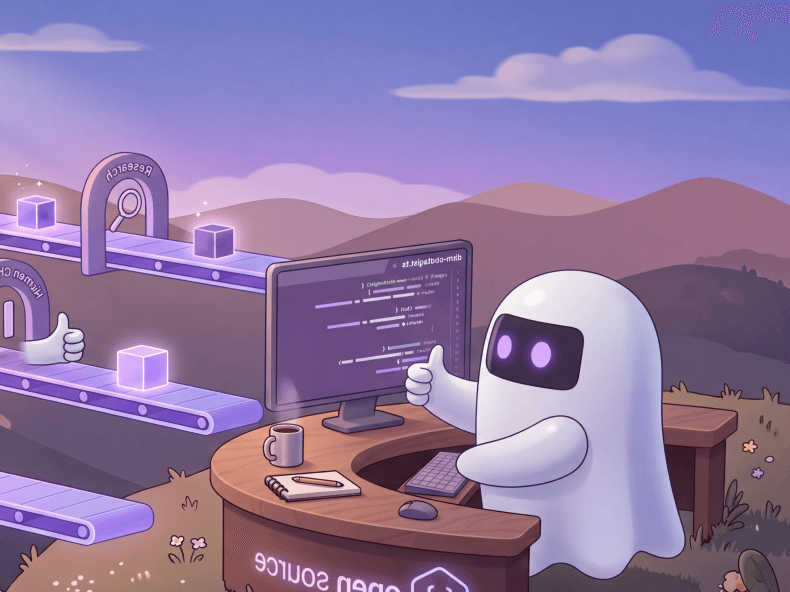
Open-source execution engine. Workflows defined in code. Human-in-the-loop checkpoints. Full audit trail on every action.
Revenue Ontology
Every data source normalized into one model. Entity resolution across systems. Relationships stored, not inferred. Schema that evolves with your business.
FAQ
FAQ
How many providers does the Waterfall use?
What happens when a provider degrades?
Can I set budget caps?
Is this just a data broker?
How fast is enrichment?

You're not in the enrichment vendor management business. Stop running it like you are.
You're not in the enrichment vendor management business. Stop running it like you are.
USE CASES
Revenue Team
Marketing Team
Customer Success
PRICING
Pricing
RESOURCES
Blog
About Lantern
Status
Support
© LANTERN 2025
Terms
Privacy

USE CASES
Revenue Team
Marketing Team
Customer Success
PRICING
Pricing
RESOURCES
Blog
About Lantern
Status
Support
© LANTERN 2025
Terms
Privacy
USE CASES
Revenue Team
Marketing Team
Customer Success
PRICING
Pricing
RESOURCES
Blog
About Lantern
Status
Support
© LANTERN 2025
Terms
Privacy